Sunday, July 24, 2011

Another Summer in Japan!

It's Summer again and (surprise, surprise) it's hot, humid and uncomfortable.

Last year we lived through Japan's hottest summer in 100 years and, it would seem, this year promises to be just as hot. Mai nichi totemo atsu-i desu-yo! (Every day it is very hot! desu-yo shows this is a statement of fact.) The hot weather arrived very quickly. Within a week we went from comfortable, mild temperatures to very hot and humid conditions.....which at a personal level equates to saturation all round! A condition further exacerbated by the fact that 'herself' has overheating issues anyway!! Thank goodness the thermostat on the air conditioner works!
Many shops try to help by cooling their customers as they enter.

With temperatures remaining in the low to upper 30's day in day out for months, the cities of Tokyo and Yokohama just never cool down. Weekly weather forecasts predict little relief.
Our apartment absorbs heat like a sponge absorbs water, air conditioners run flat out and with millions of commuters, trains can't avoid using air conditioners (even with current power restrictions). Walking to the station or around the local area can be enough to make us question why we even bothered to have a shower before leaving. Steve leaves for work before 6.30am, but wears a t-shirt for the journey and changes into his business shirt once at the office. On the way home, he often gets off one stop early and walks just to escape the hot bodies and heat of crowded peak trains.
It's hot work making pancakes!
Why is it that we are at the same latitude, but north of the equator, as Bega in NSW, Australia and we have snow in the winter then tropical, monsoonal conditions in Summer?? It's weird. It is hard to describe the heat because it can be so overwhelming. People in Steve's company, who commute between here and Papua New Guinea, say the heat here is much harder to handle. The humidity is very high and I suppose the nature of cities makes it seem hotter. Travelling on crowded trains and walking most places has an impact on the general population and their heat stress is clearly visible. So....let me introduce some of the everyday summertime accessories which help people cope.

Umbrellas, a familiar accessory all year round, are used in summer to protect the skin from the sun's damaging rays. At other times of the year, of course, they are used against the rain. I think I can safely say that the majority of women wear hats and it's not unusual to see women wearing gloves and long sleeved tops to preserve blemish free hands and arms. Bit late for me!
Many people, young and old, carry fans and small towels, commonly called handkachi. These small towels are also an all year round accessory but are particularly useful in Summer to mop the brow, neck and body. Even I carry one!
If you need an umbrella, fan or small personal towel then Japan is the place to buy one. I have always associated fans with Japan but, honestly, thought they were an ornamental accessory for a traditional costume.....kimono (the national costume of Japan), yukata (a casual version of the kimono most often worn after bathing), obi (sash), tabi (traditional Japanese socks with a separation between the big toe and the other toes), zori (open sandals), geta (high wooden based flip flops), umbrella, fan and so on.
Even 'Himself' enjoys being fanned by his fans!


Of course, it wouldn't be Japan if you couldn't select from a huge array of these items. Cheap umbrellas can be purchased at convenience stores and market areas but if it's a fashion statement you're after then there is no end to the choices. It must be a very lucrative business producing umbrellas because, in Japan alone, millions and millions are used. Small pocket versions are daijoubu desu (alright) for sun protection but are quite useless in monsoonal downpours or any breeze, clear plastic ones are great for footpath vision and normal rain but judging by the number of discarded ones are easily destroyed, there's lace edged or frilled varieties....the styles are endless.
For a variety of reasons, since arriving in Japan, we have gone through our share of umbrellas. Sometimes when out and about we'll get caught in a downpour and need to buy one or two. Others have needed replacing when they've been......left somewhere, dropped between a train and the platform, borrowed, caught in the front spokes of a bike or victims of the unexpected or even expected gust of wind! The list goes on! Damaged umbrellas are not easy to dispose of. Our rubbish collection personnel always return them to our door so, short of littering and leaving 'no longer wanted' umbrellas on the side of a footpath, you need to become a little creative. After numerous varieties, I  had purchased a decent umbrella which was extra wide and equipped with plenty of ribs but, after surviving a 'spoke' incident, it also fell victim to the wind. Unable to dispose of it at the apartment we decided to take it to a restaurant one evening and then we conveniently forgot to take it home. Oh dear, what a shame!!

Most shops and restaurants cater for patrons carrying umbrellas. Racks are a common sight and in many stores you're expected to wrap your umbrella in plastic. As you enter a store you simply push your umbrella inside a metal container which contains long plastic bags. It's surprising how much water drains into the bag! Multiply that amount by the thousands of umbrellas that could enter a store in one day and you can see why it's necessary to provide bags.
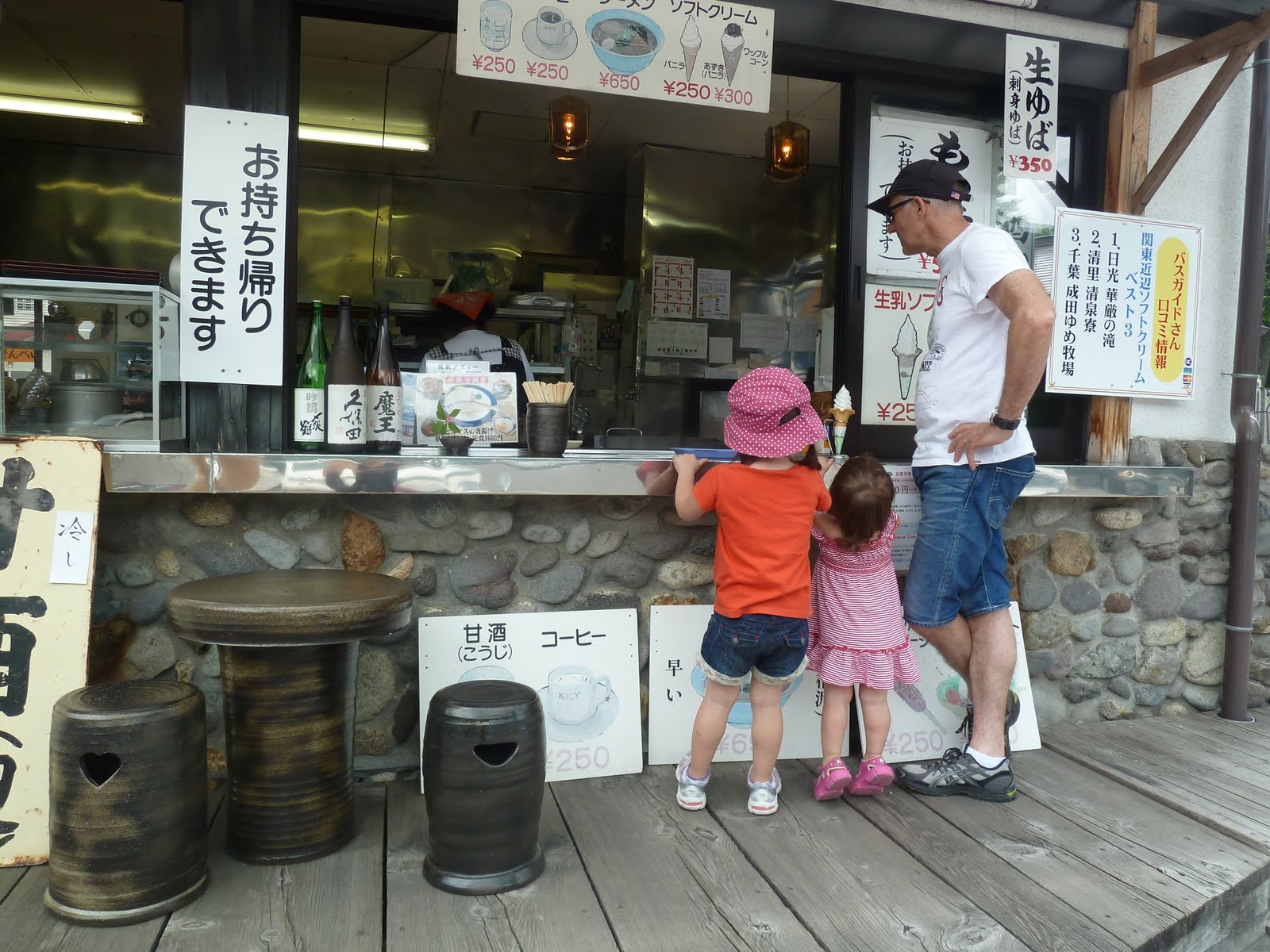
Ice creams become a normal part of the diet (how tragic is that?). My favourite ice creams are made by Meiji, the same company that makes delicious chocolate, or Lotte, also makers of good chocolate. There is a version of the Drumstick here but in Japan they are a 'cool' price, ranging between 78 and 128 yen depending where you buy them, and another favourite is one that's like an enclosed waffle. It's the same price and can easily be cut in half for two feeds as it is so big (but why would you do that?).  I have had green tea ice creams but, to date, I haven't been tempted to taste the red bean variety. I suppose I should but I hate to spoil a treat eating something I don't like! The price and taste make ice creams totally irresistible!! Most of our 'alien' visitors have succumbed, even in winter!

Not an accessory but another very familiar sight in Japan is the vending machine. They can be found everywhere.... there are numerous ones on station platforms, in the station, along streets, out in the countryside, on road sides, in stores (you name it)....they're so common, you rarely go very far before you find one. In the winter you can buy hot coffee, hot soup or food, as well as water,  but in summer it's icy cold water, coffee, tea, soft or sport's drinks and even ice creams. You usually use coins or notes but if you prefer you can use your Suica card. Most drinks range between 100 and 150 yen which is pretty cheap! I have grown quite accustomed to accessing vending machines so easily when out riding, walking, running or whatever.
 How could you not drink something that comes with this guarantee!
With 'aliens', Bek, Sophie and Harriet, back in town the heat has made many activities very difficult. A return trip to Disneyland saw us moving from one shady spot to another avoiding the sun and its heat. Quite a contrast to a visit, a few weeks earlier, with 'Team Lewis' when the weather was warm but absolutely ideal.

The 'Thompson Clan' experienced last year's hot summer and once again have felt its warmth. This year we've had a few weapons up our sleeve though. There's the Motomachi Swimming Pool, on the other side of Motomachi Street, where we've enjoyed quite a few swims. Strapped in their bike seats, the girls were always eager to head off and 'swi-i-m swi-i-m'! At 200 yen per person per one hour session or 6 sessions for 1000 yen it was fairly good value. Last year we were told Harriet couldn't go in if she wasn't toilet trained, this year we just said, 'Hai!' when they asked.
We waited until late afternoon so the girls were cooler before dinner and bedtime and it made it so much easier to enjoy a bed time story with 'Himself'.
We made a visit to the Negishi Pool, also known as the 'mammoth pool', which was terrific fun and excellent value. We spent over 3 hours there simply enjoying the immersion in water. A river pool, complete with a current, surrounds a central mammoth pool and there are a couple of other smaller pools for young children. The entry fee, 800 yen for adults and 200 yen for children, was valid for the day. Negishi is only two train stops south of us and then about a 500 metre walk. Armed with rings, sunscreen and sunnies the excursion was a great success!
It was at these pools we experienced something we had only read about. On the hour, every hour, the lifeguards (of which there were many) started blowing their whistles loudly and insistently. Everyone got out of the water and there was no swimming for 10 minutes. After a check of the pools and 'secret gestures' between the staff, the whistles signalled permission to enter the pool again. This happened three times whilst we were there.....it was really quite funny. But like all things in Japan, everyone just does it without complaint!!
We also had a great time at Hakkejima Sea Paradise, which is an aquarium with the normal walk through tunnels, including one with an escalator, lots of displays, seal, whale shark and dolphin performances and, the favourite for the girls, a touch tank you could walk in!! Both girls were soon wetter than they should have been, but they weren't alone!
 
Our trip to Nikko gave us the ultimate swimming experience though. Swimming in a pristine river, with mini rapids and inflatable rings, was perfect! Staying at the Zen Hostel, we had the river to ourselves and the only thing which signalled us to get out here was 'drinks time' or our chilled bodies.
Yes.... it's hot, very hot, and we will swelter but, I guess, we could be enduring the wet, cold Melbourne winter! Mmmm, I guess we can't complain....life is always a compromise! Of course, as I'm now a bit of a cocktail 'fan', maybe I could sip on one or two of those when I'm desperate!!
Kampaii!!! Ima watashi wa samui-i desu-yo!


North to Nikko!

Phew!! It's really quite hot in the city....let's get out of here! This was the basis for heading north and into the hills......not just a day in the hills but three. We've often considered heading north to Nikko, in the Tochigi Prefecture, but have just never got there, especially after the earthquake. So the decision was made.......Nikko it would be!
Having chosen our destination, 'Himself' organised to take a day off and 'Herself' got on the Internet to source somewhere to stay. Nikko is relatively close to Tokyo so is a popular tourist destination. Within the World Heritage Area there are an abundance of temples, shrines and parks and 'traditional Japan' has been retained within the township.

More than 70% of Nikko is designated as Nikko National Park where there are lakes, rivers, mountains and waterfalls. It is a delightful area. Just as we found on our trip to Kyoto though, three days was barely enough time.

As our aim was to get away from civilisation and the heat I was reluctant to stay within the town of Nikko. Searching around I came upon Zen Hostel, at Minami Okorogawa, which advertised river frontage and traditional ryokan style accommodation. Preferring to stay in traditional style accommodation rather than touristy high rise places, it sounded perfect...25 minutes out of Nikko and on a river that we could swim in! I read reviews and went ahead with the booking through 'hostelbookers.com'.

It was only after making the booking that I found conditions on the hostel homepage which got me worried....(quote) If you snore, you can ONLY sleep in the private annex riverside rooms. Period. Children and hostels are a complicated combination. Children under the age of 6 are only allowed in the annex private rooms which offer the most privacy and guard against noise disturbing other guests. 

Well, no one in our group snored so that was OK, but what about the children? Sophie is 4 and Harriet not yet 2 years old. Uh oh.....what will we do? Enter Scout......the hostel host. Scout immediately made contact via email and was most helpful on all fronts. He assured us that the children would not be an issue and gave us very clear instructions on how to find the hostel. He supplied a list of phone numbers and GPS references, relevant to the World Heritage area and Zen Hostel, that could be used on the iPhone and 'Honey'. He even rang us on the Friday evening to make sure we understood the directions! Thank goodness because we may never have found the hostel!

Keen to make the most of our three days and eager to beat the exodus of traffic from the city, we left Yamashita-cho at 8am. We had read it would take about 4 hours but, pleasingly, we arrived in 2.5 hours (amazing!). It was a great trip, Harriet slept most of the way and we played Spotto with Soph....10 yen to find 'whatever' and 1 yen fine if she whinged (4 year olds only worry about the number of coins anyway). We moved quickly along the expressways and outlaid 4650 yen (about $47) in toll fees for the journey.
We spent a few hours at the Heritage Area and enjoyed a snack and lunch as we meandered around. It was very hot though and we were keen to find the hostel and the river. 
Someone wished she could have this!
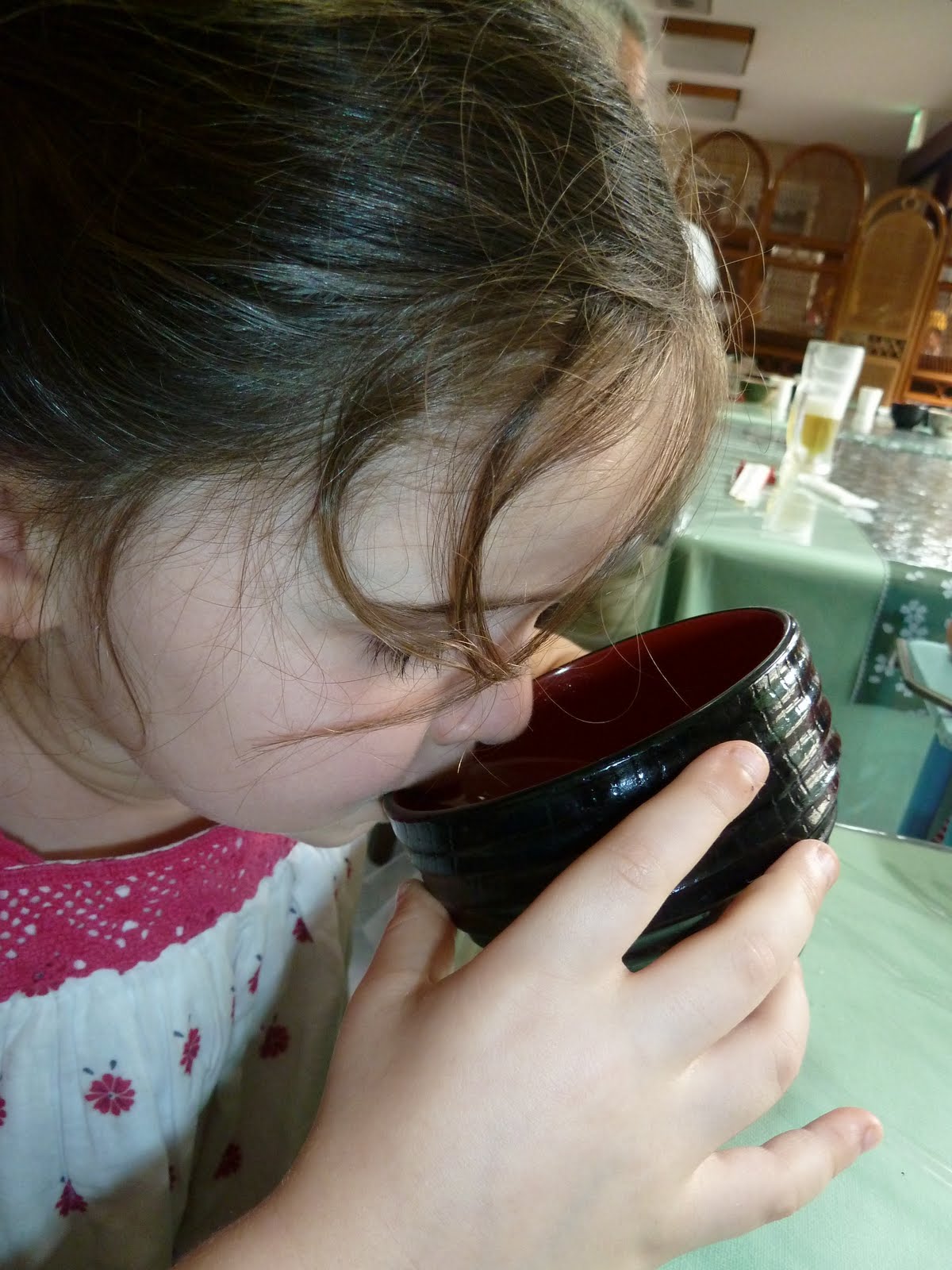
Lunch was traditional Japanese fare and both girls loved their miso soup. As usual it was shoes off and on with the 'slip ons'.

Initially, we used a map to navigate but after a couple of wrong turns we turned the reins over to Honey. We soon found ourselves heading in the correct direction. Once on the road towards the hostel we were glad we'd been forewarned....the road was bitumen but narrow, winding, isolated and through amazing tree covered hills. It was an absolutely beautiful drive, words fail me!

I immediately recognized the hostel from photos I'd seen online. Parking the car, we just sat and stared....was this really where we were spending the next two nights? There certainly wasn't a sign telling us. There appeared to be no one around so we had a bit of a wander, unsure where we even needed to go as there was no obvious reception area. At this stage a motor bike rocks up and the rider welcomes us to his hostel....it was Scout. Scout, a young American backpacker with a Japanese wife and young child, has been living in Japan for about seven or eight years and bought the hostel last year. It had been deserted for many years and Scout's dream is to do it up and possibly create a recluse for musicians or artists. He did even mention bringing a little bit of Shibuya to the hostel. An optimistic and adventurous challenge!!
We loved it! It was quirky and offered us a simply wonderful place to relax (if that's really possible with two young children, steep internal stairways and plenty of things to touch, not to mention paper wall panels!). Its remote location in a quiet, mountain valley on the banks of Kurokawa (Black River) is far from the bright city lights and shops and only accessible by car or Scout's shuttle bus.  The atmosphere was homely and down to earth. The crystal, clear river was accessed down steps directly in front of Zen Hostel and Scout supplied the necessary blow up equipment to float around in the river. Paradise.....!


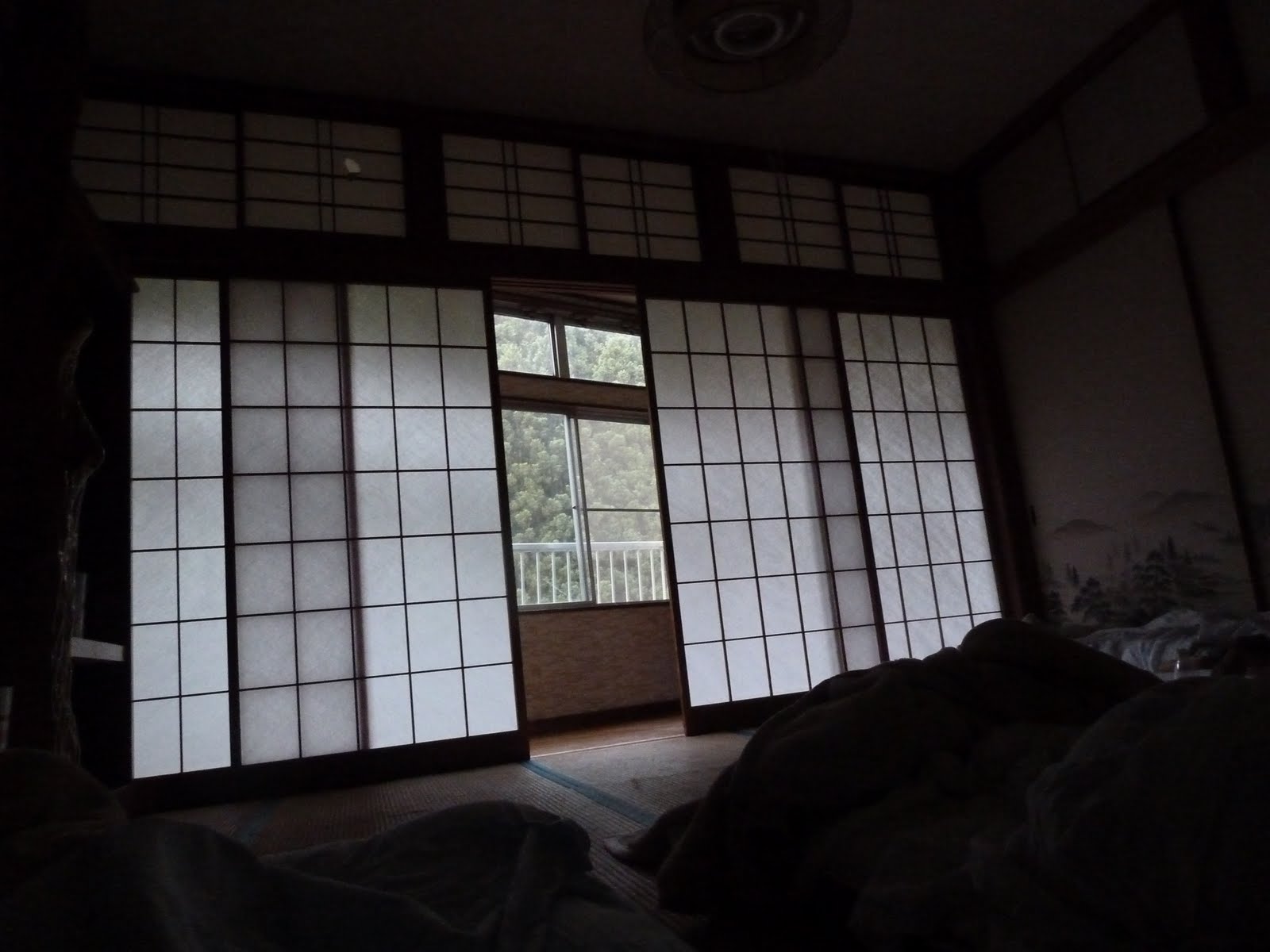
Our room, like the hostel, was huge and we had the place to ourselves, except for Scout. Perfect! Our room had traditional sliding paper and timber double doors which opened onto a sitting room area overlooking the river.
There were no air conditioners only a couple of fans and the only noise, apart from the kids, was the sound of the river. The futons were really comfy and what's more we had normal pillows, not the traditional rice husk varieties. With the doors wide open all night we picked up any slight breeze available. Adjacent to our sleeping area there was also a large lounge room. It was in here, at the traditional table with us sitting on the floor, that we enjoyed breakfast and chatting to Scout.
The bathroom area was intriguing. Initially the hostel had been run as a Japanese hot spring inn and for this purpose had been built into the rock wall of the river. The large pools still exist but sadly the cost of restoring the pumps and them is way too high. Typical of all onsens, the showers were around the pool and it was inside this cavernous area we took our showers.
Breakfast was included in the tariff and it was here that Scout really excelled. The first morning it was delicious blueberry pancakes, maple syrup, scrambled eggs and bacon with homemade bread. On the second morning it was French toast dripping in maple syrup. Freshly brewed coffee was served with each meal. It was yummy!  
Totemo oishi-i kat-ta desu. Scout san arigatou gozaimasu!

Dinner on the first evening was at an eating place, Matsuya, about 4km's away. The only customers, we felt like we had just landed unannounced at someone's home and said, 'We'd like dinner please.' There was no English, written or spoken, but we managed to communicate udon noodles and tempura. It was quite a difficult place to contain the girls and the only drink on offer was miso soup. The people were lovely though and brought out a musical toy for Sophie to play with. They also asked to take our photo (using gestures of course) and later on brought out the photos they had printed. While we were at dinner there was a spectacular thunderstorm accompanied by lots of rain. On our return to the hostel, the river was literally raging. It was hard to imagine we'd been swimming in it hours earlier......no late night swims that night!
'Himself' and even the girls enjoyed chilling out with a book!
We spent our second day in the Nikko National Park visiting waterfalls and lakes. Wow....what an area! As usual the weather was fairly warm so it was lovely to stop at all the 'watery' places. Travelling along steep, twisting roads through such incredibly lush forests we visited the spectacular Kegon Falls, Lake Chuzenji and Lake Yunoko.

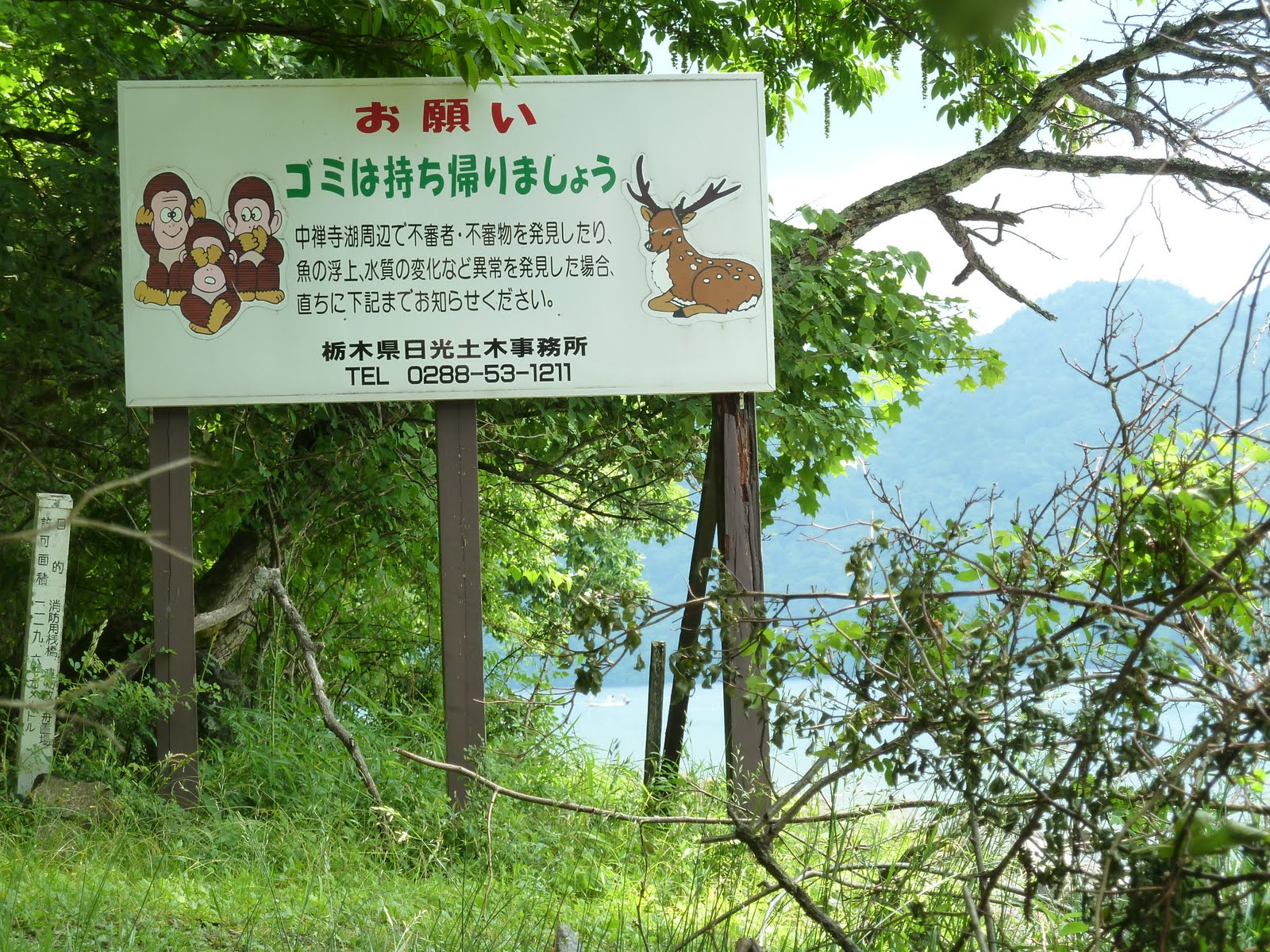
Lake Chuzenji is located at the foot of Mount Nantai, Nikko's sacred volcano. An eruption, about 20,000 years ago, blocked the valley creating Lake Chuzenji. The lake is mostly undeveloped and forested except at the eastern end where there is the small hot spring town of Chuzenjiko Onsen. 
Kegon Waterfall (Kegon no taki) is almost 100 metres high and is the only outfall for Lake Chuzenji. They are the most famous of Nikko's many beautiful waterfalls and rated as the third best in Japan. They certainly were quite spectacular and very beautiful.
Lake Yunoko is a small lake located about 6 km north-northwest of Lake Chuzenji, just north of Senjogahara marsh, 1,475 metres above sea level.  We had planned to do the boardwalk from Yutaki Falls to Senjogahara marsh but, unfortunately, a 'monsoonal' downpour put end to that idea! Instead we found somewhere to eat on the edge of the Yunodaira marsh. We had the normal ramen and miso soup but the 'Camembert Cake' for dessert was even too much for Bek (a lifelong lover of camembert)
The drive through the mountains back to the hostel was stunning. Hairpin bends (switchbacks as I called them) like I have never seen, mountain sides so steep, landslides, vegetation so dense....it was amazing.
Honey's map shows what the route was like!
On Sunday night we opted for Scout's home made pizzas and what a good choice that was. They were very, very nice and topped with lovely home grown fare. At one stage Scout disappeared in search of mushrooms and we silently hoped he remembered to return! At 1,000 yen per pizza it was a great option!
Mou ichi dou Scout san arigato gozaimasu!

We were sad to leave this delightful location and head back to Nikko for another stroll around the Heritage area before returning to Yokohama. For us, it reconfirmed it's about experiencing a little bit of the real Japan not staying in some flash hotel with all the 'mod cons'. Good luck Scout attaining your dream!
 Ganbari masu!
The insects think it is a good place to 'hang in' there!

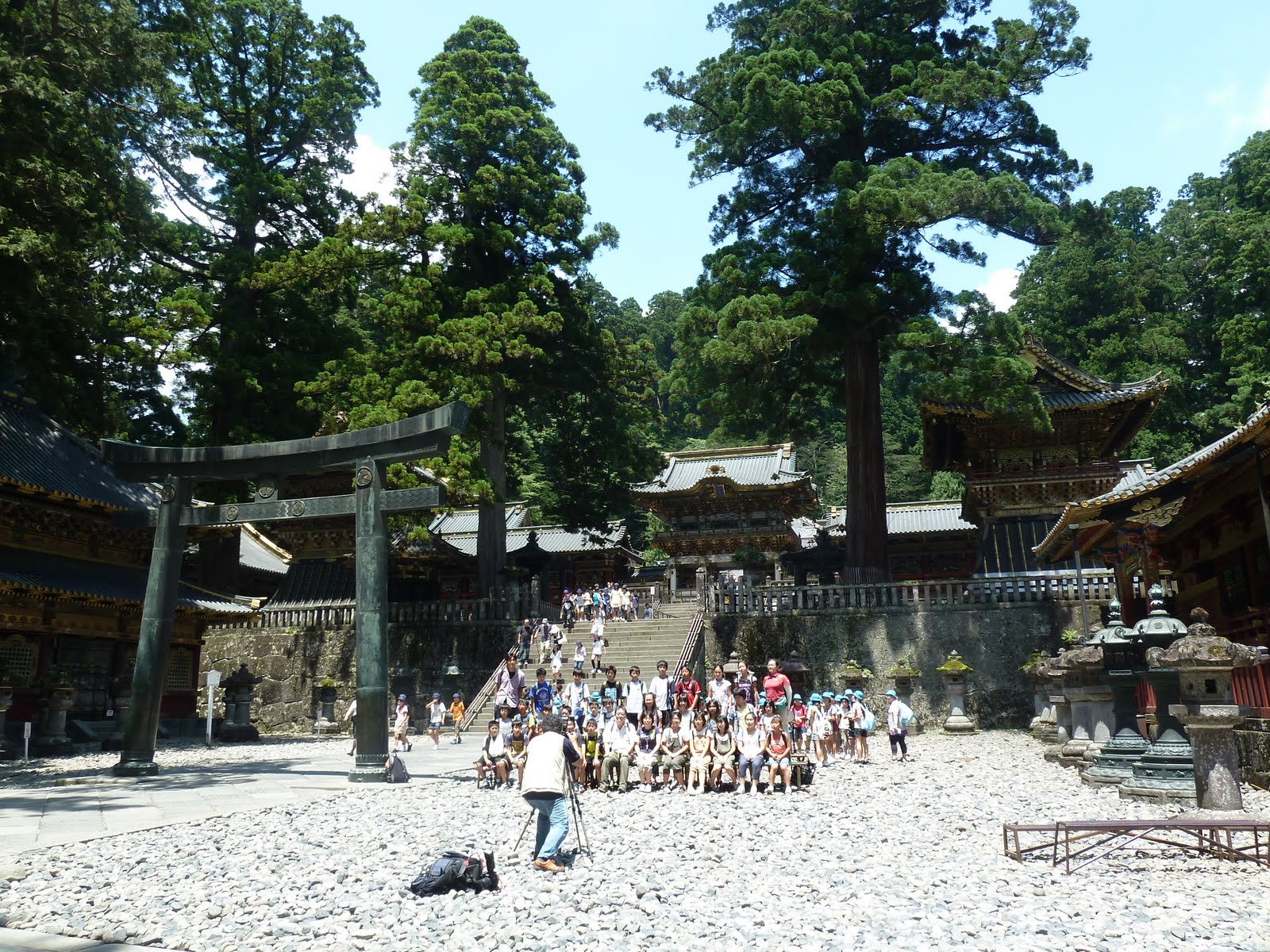
Back at the Heritage Area we purchased our combination tickets (1000 yen per person) to see the Toshogu, Rinnoji, and Futarasan temples. Paying an extra 300 yen each we gained entry to Rinnoji Shoyoen, a Japanese garden, made in the Edo Period and located next to Rinnoji Temple.  

The Edo period, from 1603 to 1868, is a time when Japan was ruled by the shoguns of the Tokugawa family, politically named the Tokugawa shogunate. The Tokugawa shogunate was overthrown by the Meiji Restoration in 1868. The Meiji period (also known as the Meiji era) lasted until 1912.

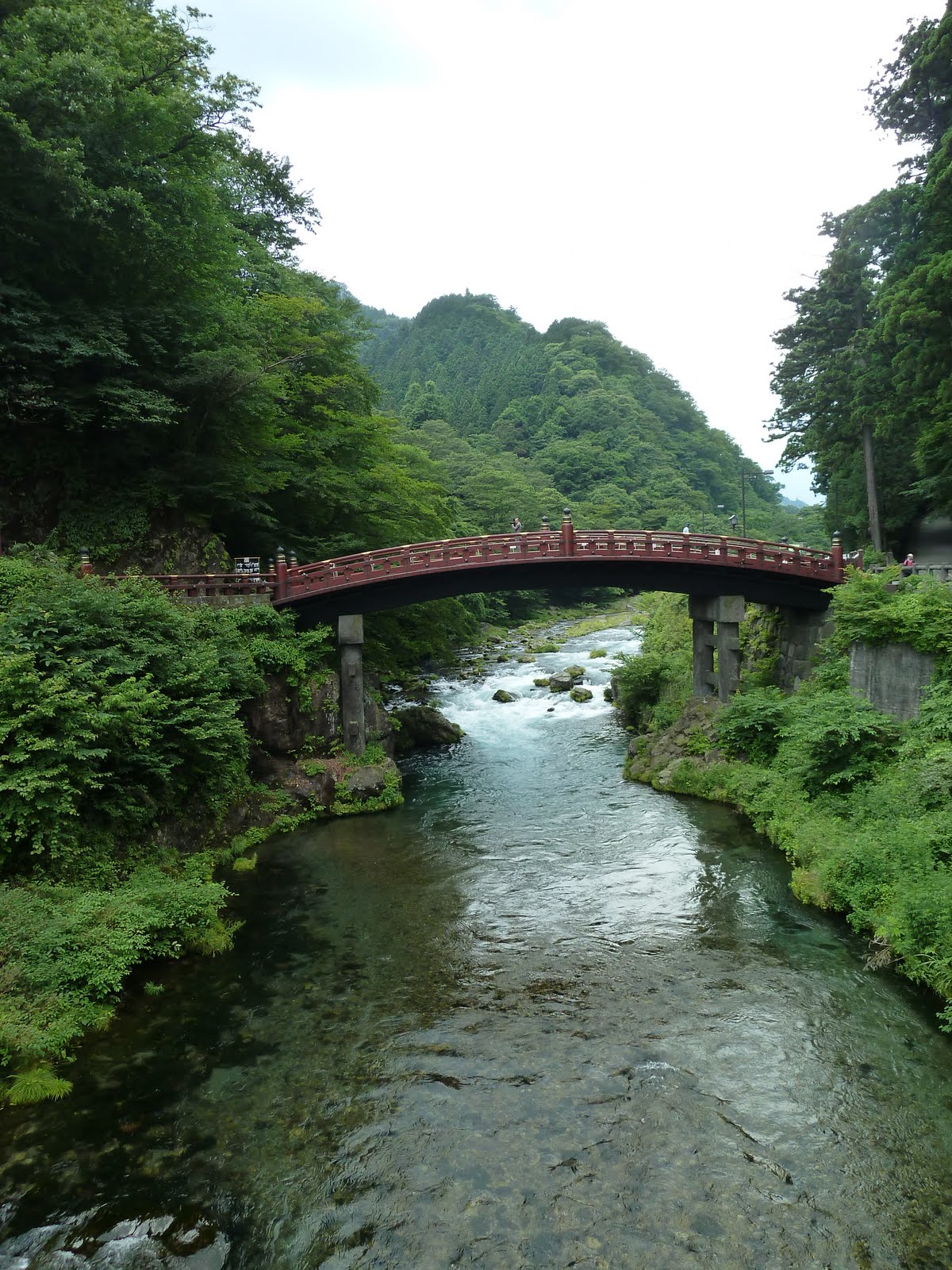
Shinkyo, the sacred bridge, stands at the entrance to the shrines and temples. It is located across the Daiya River and belongs to Futarasan Shrine. The current Shinkyo was constructed in 1636, but a bridge of some kind has been in the same spot for much longer. On the Saturday we were lucky to witness a bridal party crossing the famous bridge.
The temples were lovely and so steeped in history. Due to centuries of landscaping, the temples and shrines blend harmoniously into their natural setting. Thousands of Japanese cedars were planted during the construction period in the early 17th century and now this forest enhances the beauty and sacred character of the Heritage area. We spent a pleasant few hours wandering around enjoying the shade which the forest afforded.


 The three wise monkeys......
See no evil.....
hear no evil....
speak no evil!
Our trip back to Yokohama was as hassle free as the journey there. The toll fees were exactly the same and once again we enjoyed trying to beat Honey's estimated time of arrival! This  time Sophie slept all the way and when Harriet got fidgetty we resorted to games on the phone!

Highlights.....yummy breakfasts, Zen Hostel, swimming in the river, beautiful scenery and sights! I just wish the girls had seen some real monkeys.....but they did get other treats!